

Teen drivers are statistically the highest-risk group on the road. According to the Centers for Disease Control and Prevention (CDC), motor vehicle crashes are the leading cause of death for teenagers in the United States. The right vehicle doesn't eliminate that risk — but it can significantly reduce it.
Parents often face a familiar tension: get something cheap and hope for the best, or stretch the budget toward something safer. The good news is that this is no longer an either/or decision. Safety and affordability have become increasingly compatible in the used car market.
What Makes a Good Used Car for a Teen Driver?
Before comparing specific models, parents should know what safety and ownership factors matter most. Use this quick checklist to evaluate whether a used car is suitable for a teen driver.
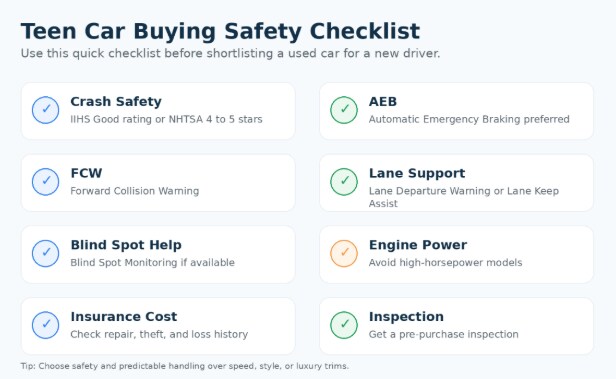
Once these basics are covered, it becomes easier to compare individual models based on safety ratings, price, reliability, and insurance costs.
Safety Ratings
Look for vehicles with:
- A Good rating in IIHS crash tests (moderate overlap front, side, roof strength, and head restraints)
- 4 or 5 stars from the National Highway Traffic Safety Administration (NHTSA)
- An IIHS Top Safety Pick or Top Safety Pick+ designation
Driver Assistance Technology
Vehicles from 2015 and newer increasingly come standard with features like:
- Automatic Emergency Braking (AEB) — IIHS research shows AEB cuts police-reported rear-end crashes in half
- Lane Departure Warning and Lane Keep Assist
- Blind Spot Monitoring
- Forward Collision Warning
These systems are especially valuable for inexperienced drivers who are still building situational awareness.
Manageable Size and Power
Avoid high-horsepower vehicles for new drivers. A smaller engine encourages safer driving habits and typically costs less to insure. Compact sedans and small crossovers strike the best balance of control and practicality.
Insurance Cost
Check the IIHS-affiliated Highway Loss Data Institute (HLDI) ratings for the model you're considering. Some vehicles cost significantly more to insure due to repair costs or theft rates — this is often overlooked in the initial purchase decision.
Best Used Cars for Teens: Our Top Picks
Each of the following vehicles has earned strong safety ratings from IIHS and/or NHTSA, offers reliable ownership costs, and can be found within a practical budget for most families.
1. Honda Civic (2019–2022)
The Honda Civic is one of the most well-rounded used cars for teen drivers on the market. The 2022 model earned a 5-star overall NHTSA rating and includes Honda Sensing — a standard suite that covers forward collision warning, automatic emergency braking, lane departure warning, and adaptive cruise control. Fuel economy averages around 32 mpg combined, and the Civic's long-term reliability is among the best in its class.
- Best model years for used buyers: 2019–2022
- Estimated used price range: $17,000–$24,000
2. Toyota Corolla (2018–2022)
The Toyota Corolla has been an IIHS Top Safety Pick for over a decade. It's known for exceptional reliability (Lexus and Toyota ranked first and second in J.D. Power's 2024 Vehicle Dependability Study), low insurance costs, and a predictable, easy-to-handle driving experience ideal for new drivers.
Every Corolla from 2017 onward includes Toyota Safety Sense — a standard suite that covers pre-collision warning with pedestrian detection, lane departure alert, and automatic high beams.
- Best model years for used buyers: 2018–2022
- Estimated used price range: $16,000–$23,000
3. Mazda3 Sedan or Hatchback (2019–2023)
The Mazda3 sedan earned IIHS Top Safety Pick+ and a 5-star overall NHTSA rating for multiple model years. In 2025, Mazda led the industry in total IIHS safety awards—a strong signal of the brand's sustained commitment to crash protection.
The Mazda3 also offers a more engaging driving feel than most competitors, which some teens and parents prefer because it encourages active attention behind the wheel. The base model comes well-equipped with safety tech, keeping costs manageable.
-
Best model years for used buyers: 2019–2023
-
Estimated used price range: $18,000–$26,000
4. Hyundai Elantra (2017–2022)
The Hyundai Elantra offers the most rear-seat and trunk space in its compact segment, making it a practical choice for teens who regularly carry passengers. The 2022 model received a 5-star overall NHTSA rating and includes standard driver-attention monitoring, blind-spot monitoring, and automatic emergency braking.
Hyundai secured the most IIHS safety awards among all manufacturers in 2024, making models from this era particularly well-suited for first-time drivers.
- Best model years for used buyers: 2017–2022
- Estimated used price range: $14,000–$22,000
5. Subaru Crosstrek (2018–2023)
If your teen lives in a region with snow or heavy rain, the Subaru Crosstrek's standard all-wheel drive is a meaningful safety advantage. Every Crosstrek comes with Subaru's EyeSight Driver Assist Technology, which includes adaptive cruise control, lane keep assist, pre-collision braking, and sway warning.
Between 2013 and early 2025, Subaru earned 74 IIHS Top Safety Pick+ awards—more than any other brand.
- Best model years for used buyers: 2018–2023
- Estimated used price range: $20,000–$28,000
6. Kia Soul (2017–2022)
The Kia Soul has earned back-to-back recognition as a top-rated car for teen drivers from multiple independent automotive safety and consumer organizations, thanks to its combination of strong safety scores, low ownership costs, and easy handling.
- Best model years for used buyers: 2017–2022
- Estimated used price range: $12,000–$20,000
Comparison Table: Top Used Cars for Teen Drivers
Prices are approximate and reflect used market conditions as of mid-2025. Actual pricing varies by trim, mileage, and region.
How Much Should You Spend on a Used Car for a Teen?
A common mistake is spending too little. While a $5,000–$7,000 car may seem appealing, vehicles in that range are often older and may lack critical safety technology. Researchers at IIHS specifically caution against placing new drivers in very old cars that lack crash protection and modern safety aids.
A practical framework:
- Under $10,000: Good Choices exist on the IIHS/CR list—these have strong crash test ratings but may not include AEB or advanced headlights. The 2025 list includes 74 used vehicles under $10,000 that qualify.
- $10,000–$20,000: Best Choices on the IIHS/CR list—these add standard AEB and high-quality headlights, significantly improving crash prevention. 48 models qualify at this tier.
- $20,000+: Broader selection including compact crossovers with AWD and more complete driver-assist suites.
Don't overlook the total cost of ownership. A slightly more expensive vehicle with better fuel economy, lower insurance costs, and a stronger reliability record will often cost less over three to five years than a cheaper car with higher running costs.
What Safety Features Should a Teen's Car Have?
This is one of the most common questions parents ask. Here are the features to prioritize in order of importance:
Must-have features:
- Automatic Emergency Braking (AEB) — reduces rear-end collisions significantly
- Forward Collision Warning (FCW)
- Good crash test ratings in IIHS and NHTSA evaluations
Highly recommended features:
- Lane Departure Warning / Lane Keep Assist
- Blind Spot Monitoring
- Rear Cross-Traffic Alert
- Backup camera (standard on all vehicles made after May 2018)
Helpful but not critical for most teens:
- Adaptive Cruise Control
- Traffic Sign Recognition
- Automatic High Beams
Driver monitoring systems—which alert drivers who appear inattentive—are worth seeking out in used vehicles from 2020 onward if budget allows.
Are Older Cars Safe for Teen Drivers?
This is a nuanced question. A 2010 Honda Civic is mechanically reliable—but it lacks the crash protection and driver-assist technology of a 2019 model. IIHS notes that older vehicles, even from reputable brands, often fail to meet current crash test standards because those standards have been raised significantly since 2012.
If budget constraints push you toward an older vehicle, prioritize:
- Model years 2012 and newer at a minimum
- Vehicles from brands with strong historical safety records (Honda, Toyota, Subaru, Mazda)
- A pre-purchase inspection from a trusted mechanic to identify structural or safety issues
Bottom line: A newer car with slightly higher mileage is generally a safer choice than an older car with lower mileage when safety technology is the deciding factor.
Does Car Type Affect Teen Insurance Rates?
Yes—significantly. Teens are already the most expensive category of drivers to insure. The average six-month insurance premium for a teen driver runs around $1,300, but the vehicle itself can push that figure higher or lower.
Factors that increase teen insurance costs:
- High-horsepower engines
- Sports cars or performance trims
- Vehicles with high theft rates
- High-repair-cost vehicles (certain European models, luxury brands)
Factors that lower teen insurance costs:
- Good safety ratings (insurers reward this)
- Lower engine displacement
- Vehicles with anti-theft systems
- Vehicles with low historical loss claims (check HLDI data)
The Honda Civic, Toyota Corolla, and Hyundai Elantra consistently score well on insurance cost metrics, making them practical choices for families trying to keep monthly expenses under control.
Frequently Asked Questions
1. What is the safest used car for a teenage driver?
The Honda Civic (2019–2022) and Mazda3 (2019–2023) are among the safest used cars for teen drivers based on IIHS Top Safety Pick+ ratings and standard automatic emergency braking. The Toyota Corolla is also a consistent top performer across multiple rating categories.
2. What is a good budget for a first used car for a teen?
Most safety experts recommend a budget of at least $10,000–$15,000 to access vehicles with modern safety technology, including AEB. The IIHS/Consumer Reports joint list includes strong options in both the under-$10,000 and under-$20,000 tiers.
3. Should I buy a new or used car for my teen?
A used car typically offers better overall value. Well-maintained models from 2018–2022 provide modern safety technology at a fraction of new car prices, and the depreciation hit has already been absorbed by the first owner.
4. Are SUVs safer for teen drivers than sedans?
Not necessarily. Larger SUVs can increase rollover risk and are harder for new drivers to maneuver. Compact crossovers like the Subaru Crosstrek or Honda HR-V offer SUV practicality with the handling characteristics of a smaller vehicle — making them a better fit for most teen drivers.
5. What used cars should teen drivers avoid?
Avoid high-horsepower sports cars, vehicles with poor IIHS ratings, older vehicles predating 2012, and any model with high insurance loss rates according to HLDI data. Also, avoid cars with deferred maintenance or unknown accident history — always request a vehicle history report.
Ready to find the right used car for your teen driver?
Browse Axio Auto's inventory of certified pre-owned vehicles, including top-rated picks from Honda, Toyota, Mazda, and Hyundai. Every listing includes vehicle history details to help you make a confident, informed decision.
