

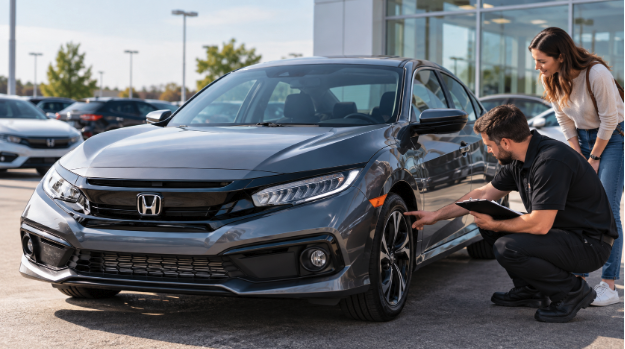
A used Honda Civic can be a practical choice if you want an efficient compact car for commuting, school, errands, or everyday driving. Civics have a long-standing reputation for reliability, but the condition of the individual vehicle matters just as much as the model year.
Before buying, compare the vehicle's mileage, maintenance history, accident history, engine and transmission, tires, brakes, and recall status. You can enter the VIN into the official NHTSA recall lookup tool to check whether the car has an unrepaired safety recall.
Used Honda Civic Model Years at a Glance
These ranges are starting points rather than automatic recommendations. Reliability sources use different methods and do not always agree on the best year for Honda Civic ownership. A well-maintained vehicle from a less-discussed year can be a better purchase than a neglected example from a highly rated year.
How Reliable Is a Used Honda Civic?
Honda Civic reliability is one reason the model remains popular with used-car buyers. RepairPal gives the Civic a 4.5 out of 5 reliability rating, with average annual repair and maintenance costs of about $368.
Actual costs depend on the car’s age, mileage, condition, and maintenance history.
Before buying, check the engine fluids, transmission, brakes, tires, suspension, warning lights, AC, leaks, service records, and accident history.
A Civic with good maintenance records can be a better choice than a lower-mileage car with little service history.
Honda Civic Years to Avoid or Inspect More Carefully
Searches for Honda Civic years to avoid often produce conflicting answers because different sources evaluate reliability differently. Instead of automatically excluding a model year, treat certain generations as reasons to investigate more carefully.
Lists of Honda Civic years to avoid should be used as a research tool rather than as the only reason to reject a particular car. The individual vehicle’s condition, maintenance history, and inspection results matter just as much as the model year.
How Long Do Honda Civics Last?
There is no guaranteed mileage limit. Vehicle lifespan depends on maintenance, climate, driving habits, accident history, and how previous owners treated the car.
A higher-mileage Civic should not automatically be ruled out. For example, a car with extensive highway mileage and documented maintenance may be in better mechanical condition than a lower-mileage vehicle that mainly made short trips and received irregular servicing.
When deciding whether the mileage is acceptable, ask:
-
Were oil changes performed regularly?
-
Has the transmission been serviced as recommended?
-
Have major wear items already been replaced?
-
Is there documentation for previous maintenance?
-
Does the engine start smoothly when cold?
-
Are there leaks, smoke, vibrations, or unusual noises?
If you are wondering how long Honda Civics last, focus less on finding a specific mileage number and more on determining how well that particular Civic has been maintained.
What Should You Inspect Before Buying a Used Honda Civic?
A test drive should help you spot possible problems before buying.
Engine: Start the car cold if possible. Listen for unusual noises and check for warning lights.
Transmission: Make sure acceleration and shifting feel smooth, with no slipping or hesitation.
Steering and Suspension: Drive on different roads. Watch for pulling, rattles, or clunks.
Tires and Brakes: Check all four tires for uneven wear. Braking should feel smooth without vibration or pulling.
Interior Electronics: Test the camera, AC, windows, locks, USB ports, and infotainment system.
For safety information, check the Insurance Institute for Highway Safety's Honda Civic ratings.
Honda Civic Maintenance Cost: What Should Buyers Expect?
Honda Civic maintenance cost depends heavily on the age and condition of the car.
Normal ownership expenses can include:
-
Oil and filter changes
-
Brake pads and rotors
-
Tires
-
Batteries
-
Transmission service
-
Coolant service
-
Spark plugs
-
Suspension components
-
Air-conditioning repairs
RepairPal's current estimate of approximately $368 in average annual Civic repair and maintenance expenses can provide a general benchmark, but it should not be treated as a prediction for a specific used vehicle. Older or higher-mileage cars may require several wear items at the same time.
When calculating the real Honda Civic maintenance cost, consider what the vehicle may need during your first year of ownership, not just what it costs to purchase today.
For example, a Civic priced slightly lower may not actually be the better deal if it immediately needs four tires, brakes, suspension work, and overdue maintenance.
Check Fuel Economy, Safety, and Recall Information
Independent resources can make comparing used Civics easier.
Use:
-
NHTSA's recall lookup to search a VIN for unrepaired safety recalls.
-
FuelEconomy.gov to compare official EPA fuel-economy estimates by model year and configuration.
-
IIHS vehicle ratings to research crashworthiness and available safety technology.
Fuel economy can vary depending on engine, transmission, trim, model year, and driving conditions, so compare the exact Civic you are considering rather than relying on a general Civic MPG figure.
Should Mileage or Model Year Matter More?
Neither number tells the complete story.
Consider two vehicles:
Civic B may ultimately present the lower ownership risk.
Use mileage as one factor alongside service history, vehicle condition, ownership history, price, and inspection results.
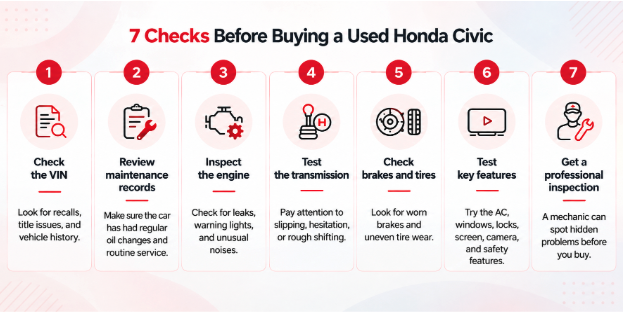
7 Checks Before Buying a Used Honda Civic
Compare the Vehicle's Price With Its Overall Condition
Do not judge a used Civic by its advertised price alone. A lower-priced vehicle may seem like a good deal at first, but upcoming repairs or overdue maintenance can increase the total cost of ownership.
Compare the model year, trim level, mileage, vehicle history, maintenance records, tire condition, expected repairs, available features, and local market pricing. Looking at these factors together gives you a clearer idea of whether the vehicle offers good value.
If you plan to finance your purchase, you can review Axio Automotive's financing options to better understand your payment options before choosing a vehicle.
Axio Automotive also provides service and maintenance support after purchase, helping you stay on top of routine vehicle care.
Final Thoughts
A used Honda Civic can make sense for commuters, students, first-time buyers, and drivers looking for an efficient everyday car. But choosing the right one means looking beyond the Civic nameplate.
Compare model years, but prioritize the individual vehicle's maintenance records, mechanical condition, mileage, history, and price. Research known issues, check the VIN for recalls, take a thorough test drive, and arrange an inspection when appropriate.
The right Civic is ultimately the one that fits your budget and driving needs while showing evidence that previous owners maintained it properly.
Frequently Asked Questions
Is a used Honda Civic reliable?
Honda Civic reliability is generally considered strong, and RepairPal currently rates the Civic 4.5 out of 5. However, reliability varies by model year, mileage, previous maintenance, and vehicle condition, so buyers should inspect the individual car rather than rely on the model's reputation alone.
What mileage is too high for a used Honda Civic?
There is no single mileage at which a Civic becomes a bad purchase. A higher-mileage car with detailed service records and good mechanical condition may be preferable to a lower-mileage car that has been poorly maintained.
What is the best year for Honda Civic buyers?
There is no universal best year for Honda Civic shoppers. Models such as 2011, 2013–2015, and several later tenth-generation years frequently appear favorably in used-car reliability research, but the condition and history of the individual vehicle should carry more weight than the year alone.
Which Honda Civic years should I inspect carefully?
When researching Honda Civic years to avoid, buyers commonly encounter concerns around some early-2000s automatic models, certain 2006–2009 vehicles, the first-year 2016 redesign, and some newer model years with recall or complaint histories. Check the exact VIN, maintenance history, and mechanical condition before making a decision.
How much does it cost to maintain a Honda Civic?
The Honda Civic maintenance cost varies based on age, mileage, location, and repair needs. RepairPal currently reports an average annual repair and maintenance cost of about $368 across Civic model years, but an older used Civic may require more depending on deferred maintenance and worn components.
